



Why the Best Spaces Are Created Together
After more than 25 years in design, I’ve learned that one of the most beautiful parts of our work is that we don’t have to know everything.
Actually, I think the best results often happen when we don’t try to.
One philosophy I’ve learned to embrace, both in life and in my work, is to always approach things with a beginner’s mindset. To look at life as if everything is new. To stay curious, ask questions, listen, and never assume that experience means there is nothing left to learn.
I believe there is something beautiful about allowing yourself to see things with fresh eyes, even after doing something for many years. Experience gives us knowledge, but curiosity keeps us growing.
And I think that is especially important in design.
A beautiful home can involve so many different minds and hands. An architect. An interior designer. A contractor. An artisan. A lighting specialist. A stylist. A client who knows exactly how they want to feel, even if they don’t yet know how to translate that feeling into a room.
Everyone sees something different.
And when the collaboration is right, those differences become part of the magic.
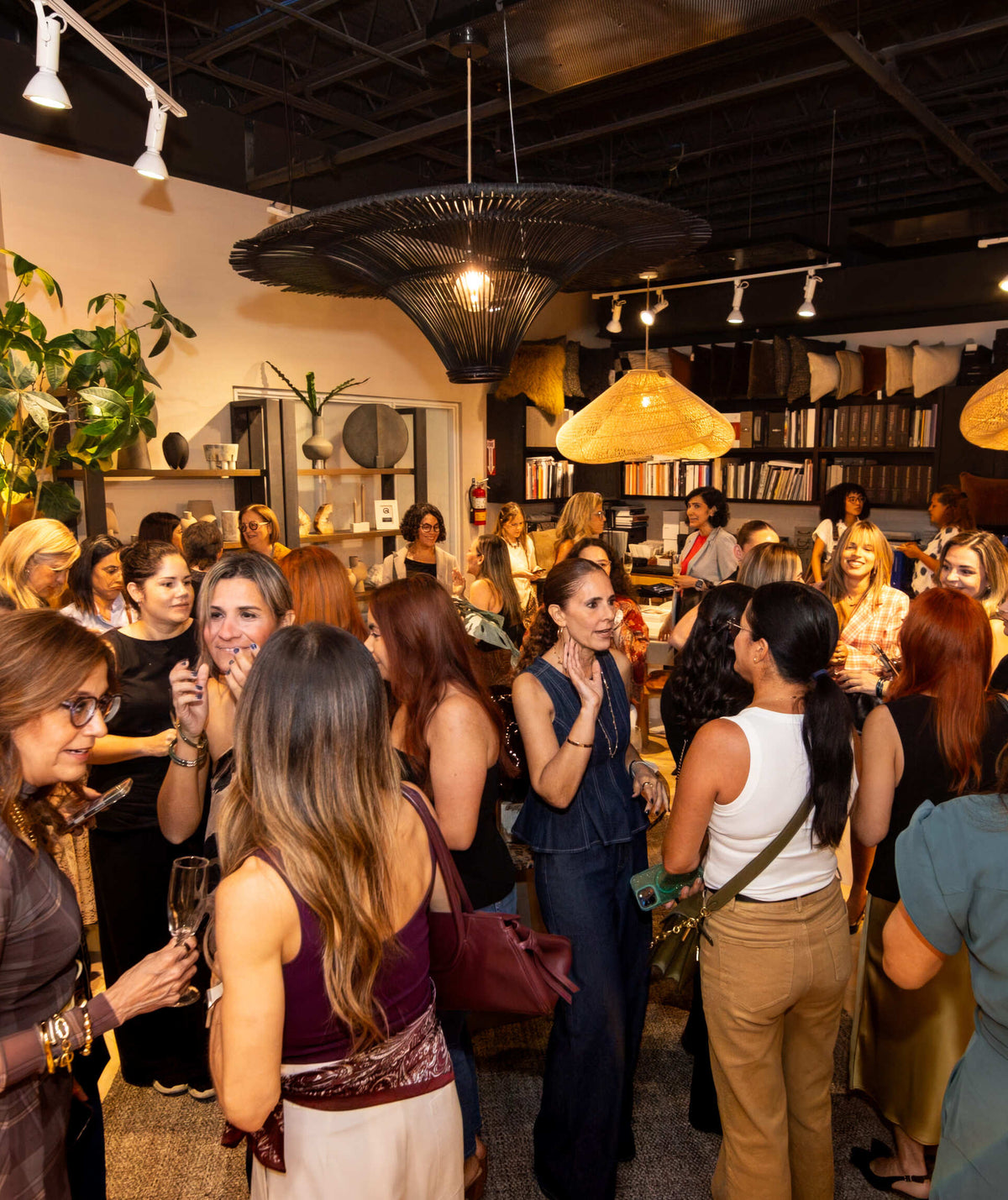
I was reminded of that recently while hosting an evening with Women in Architecture here in Puerto Rico at our Store. Being surrounded by architects and design professionals, exchanging ideas and perspectives, brought me back to something I have learned again and again throughout my career: the best work happens when we are open to what others can bring to the table.
I left thinking less about any one project and more about how much trust is involved when creative people work together.
Because collaboration in design is not simply about putting more talent around a table.
It is about knowing when your expertise should lead, when it should support, and when the best thing you can do for a project is make room for someone else’s.
Knowing what the space needs
When I was younger, I think I felt a greater responsibility to have every answer.
Experience changes that.
After enough years, enough projects, and enough mistakes, you begin to understand that being a good designer is not about proving how much you know.
It is about learning how to see.
What does this home already have?
What did the architect intend?
What does the client already love?
What is working beautifully?
What still feels unresolved?
And most importantly: what does this space actually need?
Sometimes the answer is architecture.
Sometimes it is a larger interior design intervention.
And sometimes the bones are already beautiful.
The space doesn’t need to be reinvented.
It needs to be completed.
That might mean furniture with the right scale. Better lighting. A rug that finally connects everything. Art. Objects. Texture. Pieces the client already owns but has never quite known where to place.Those decisions can look small on paper, but anyone who works in design knows how much they can change the feeling of a room.
There is a kind of magic in that final layer.
Not because we are adding more.
Because we are helping everything that is already there begin to speak to each other.
Collaboration should make a project more personal, not less
One of the fears people sometimes have when several creative professionals are involved is that the project will lose its clarity.
Too many opinions. Too many styles. Too many directions.
And yes, that can happen.
But I don’t believe that is a collaboration problem.
I believe it is a listening problem.
The best collaborations I have experienced begin with respect.
Respect for the architecture.
Respect for the person who started the project.
Respect for what has already been decided.
And above all, respect for the client.
Because the client is not simply the person we are designing for. They are one of the most important voices in the creative process.
I’ve learned that some of the best ideas come when we truly listen. Sometimes we present a design solution, and the client brings a different perspective, asks a question, or suggests something we hadn’t considered. And suddenly, together, we arrive at something even better.
I love those moments.
They remind me that creativity doesn’t belong to any one person in the room. Our expertise brings knowledge, experience, and possibilities, but our clients bring something equally valuable: their own perspective, instincts, lifestyle, and understanding of what feels right for them.
To me, design has always been a conversation. A creative exchange where ideas evolve, where we learn from one another, and where the final result becomes richer because everyone has contributed.
The goal should never be for someone to walk into a home and immediately recognize which professional touched which part of it.
The goal is for the people who call that space home to see themselves reflected in it.
That is a very different way of approaching design.
It means I don’t need to put my fingerprint on everything.
Sometimes my role is to transform the entire environment.
Sometimes it is to help finish one important room.
Sometimes it is to edit.
Sometimes it is to find one extraordinary piece.
And sometimes it is to take what another creative professional has already done beautifully and help carry that intention through the last layers of the home.
Where DeCoLab comes into the conversation
That belief in collaboration is part of why we created DeCoLab.
DeCoLab gives us a way to enter a project without needing to reinvent it.
We can begin with the architecture that is already there.
The furniture the client already loves.
The vision another professional has already established.
Then we ask: How do we help all of this come together?
That question feels much more generous to me than beginning with, “What can we change?”
DeCoLab was created as a collaborative decoration, furnishing, curation, and styling service, built on the belief that a new perspective does not have to mean starting over.
When we work alongside architects and other design professionals, our role can be to carry their original intention through the furnishing and styling stages; not compete with it.
That continuity helps the space feel cohesive and gives the client a more connected experience from the architecture to the finishing touches.
Existing pieces, another professional’s vision, and the client’s own story can all be respected and brought together in the final result.
And just as importantly, the client remains part of that conversation throughout the process. Their ideas, reactions, and perspectives help shape the decisions we make together.
Because the most beautiful outcome is not necessarily the one we originally imagined.
Sometimes it is the one we discover together along the way.
Maybe the real skill is knowing when to invite someone in
I think this applies far beyond design.
As we grow in our careers, it is easy to believe that expertise means becoming more independent.
I have found almost the opposite.
The more experience I have, the more I value the people around me.
The person who knows something I don’t.
The person who sees something differently.
The person who can take an idea further than I could alone.
And sometimes, the client who reminds me to look at something from a completely different perspective.
There is confidence in saying, this part is mine.
But there is also confidence in saying, this is where someone else can make this better.
And I think clients feel that.
They feel when the people around their project are protecting their own territory.
And they feel when everyone is protecting the vision instead.
Those are two very different experiences.
So when I think about collaboration now, I don’t think about dividing up a project.
I think about bringing together the right people, at the right moment, around one shared intention.
To create a space you love living in, one that feels cohesive and true to you.
Something thoughtful, personal, and connected in every detail.
Something that could not have been created in exactly the same way by any one of us alone.
And perhaps that brings me back to the beginner’s mindset I try to carry through life.
To remain curious. To listen. To be open to a better idea, even when it isn’t my own.
Because no matter how many years we have been doing something, there is always something new to learn, another perspective to discover, and another opportunity to create something beautiful together.
Maybe that is what good collaboration really is.
Not adding more voices.
Bringing together the right ones.
And allowing a space to become more complete because of it.
Discover DeCoLab and explore how we can collaborate on your next project, while honoring the vision that makes it yours.
xL

